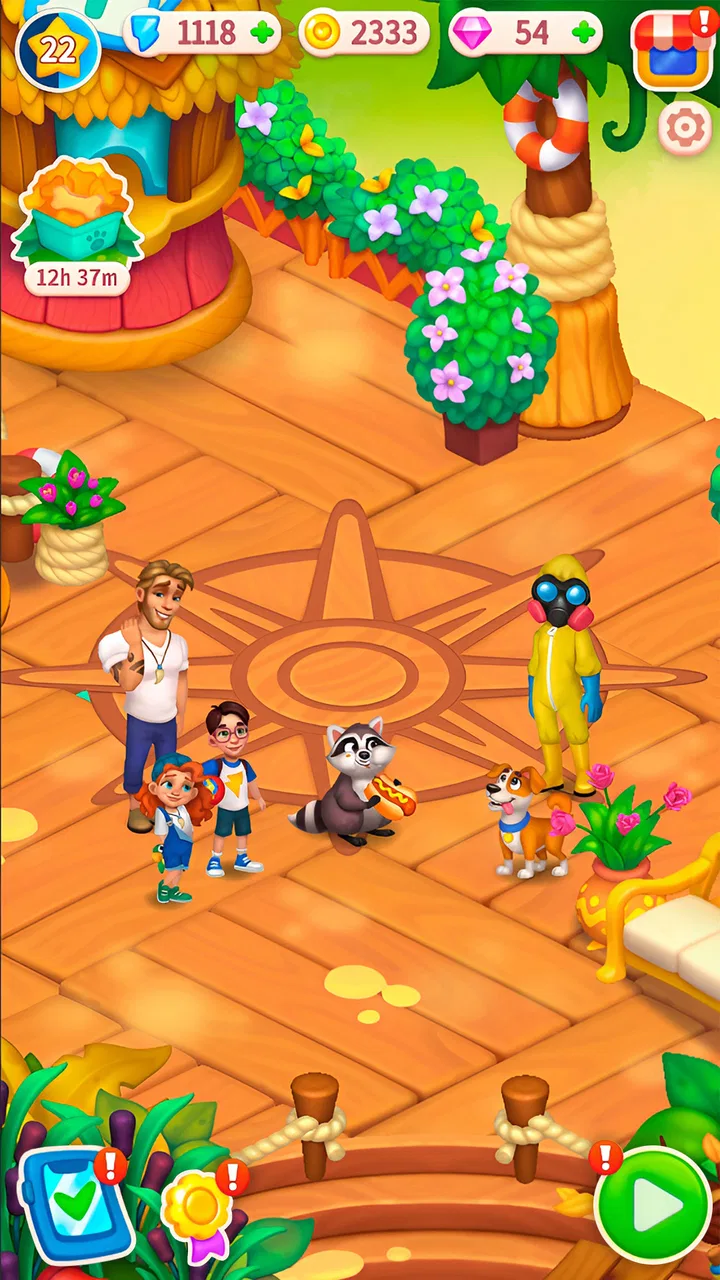
Secrets of Paradise Merge Game
- 4.6
- Rating
- 1.00M
- Installs
- Free
- Price

 Analysis by App-foxy
I approached Secrets of Paradise Merge Game expecting a relaxed puzzle experience, but what stood out first was the way its island setting gives the familiar merge formula a clearer sense of purpose. You join Ellie while restoring a damaged-looking paradise and gradually exploring its mysteries, so each small puzzle decision feels connected to a larger place rather than being an isolated board exercise. That framing makes a difference when I want something easy to pick up but still capable of holding my attention for more than a few minutes.
This is a free puzzle game from UGO Games, rated Teen, and it has already attracted more than a million installs. Its average score sits at 4.6 from roughly sixteen thousand ratings, which suggests that the combination of merging, rebuilding, and discovery has found a sizeable audience. I would not treat that score as a guarantee that everyone will enjoy it, though. The best fit is someone who likes gradual progress, visual restoration, and light mystery more than fast action or highly competitive play.
How the island adventure feels in everyday play
The central appeal is the rhythm of combining matching objects, using the results to move restoration forward, and seeing the island become more inviting over time. I like this structure because it gives ordinary puzzle moves a visible consequence. Instead of clearing a board simply to reach a score, I am working toward a place that feels as if it is changing because of my decisions.
You May Also Like

 Blood Strike: 2.5 Anniversary
Blood Strike’s Loadouts Turn Every Drop Into a Tactical Gamble
A close look at Blood Strike’s custom loadouts: how fast access to signature weapons reshapes its battle royale rhythm, rewards preparation, and narrows the gap between fights.

 Pandora - Music & Podcasts
Pandora’s Music Is Easy to Start, but Harder to Recover
Pandora’s strength is its low-effort path from a seed to a station. Its weak spot is how much confidence it asks you to place in connection, setup, and quiet recovery.

 8 Ball Pool
 Is Built on Rivalries, Rematches, and Routine
A close look at the rivalries, rematches, shared routines, and unanswered safety questions that turn a quick pool match into a persistent mobile community.

 Samsung Music
’s Quiet Strength Is Playing What You Already Own
Its reach comes less from spectacle than from dependable access to a personal library. That simplicity is both the app’s strongest retention engine and its ceiling.

 AccuWeather: Weather Radar
AccuWeather Review: A Quick, Clear Forecast for Everyday Decisions
For everyday plans, the best forecast is the one you can understand quickly. AccuWeather makes rain timing, radar, and local conditions easy to act on, with a few trade-offs.

 Hill Climb Racing
Why Hill Climb Racing Still Turns Crashes Into One More Run
A tiny car, a bumpy hill and one more upgrade: Hill Climb Racing keeps resurfacing because its simple chaos makes every near-miss feel personal.
More From Our News Desk
View All News


That makes the game particularly suitable for short sessions. I can open it while waiting for an appointment, complete a few useful actions, and leave without needing to remember a complicated control scheme. At the same time, the island theme gives me a reason to return when I have more time. The mystery element adds curiosity, while the rebuilding objective supplies a steady sense of direction.
The important thing is to understand what kind of puzzle game this is. It is not designed around reflexes, rapid swipes, or difficult logic problems that demand complete concentration. Its challenge comes more from managing a limited play space, recognizing useful combinations, and deciding which progress is worth pursuing first. Players who enjoy planning several moves ahead will get more from it than people looking for instant, high-intensity puzzles.
Why the merge loop works here
Merge games can become repetitive when combining objects feels like a chore between rewards. In this case, the island setting helps soften that repetition. A merge is not only a number going up; it supports the wider feeling that Ellie is uncovering and repairing something. I found that context useful because it gave me a reason to care about the next step even when the individual action was simple.
My practical advice is to avoid treating every available combination as equally valuable. Before merging, I would look at the open space around the objects and consider what the resulting item might block. A quick combination can feel satisfying, but careless placement can make the board harder to manage later. Keeping a small amount of room open is often more useful than filling every gap immediately.
That is one of the less obvious skills in this type of game: space is a resource. A player who focuses only on producing higher-level objects may end up with a crowded board and fewer flexible choices. I prefer to preserve a working area, group related pieces when possible, and delay a merge if it would create clutter without helping the current restoration goal.
Using the island as a progress guide
The rebuilding layer is more than decoration because it gives the puzzle loop a readable destination. When I am unsure what to do next, I find it more useful to think about the current island objective than to chase every possible merge. That approach reduces aimless play and helps separate meaningful progress from activity that merely consumes space or resources.
This also makes the game approachable for people who do not usually play puzzle titles. The island provides a gentle narrative reason to continue, while the merge actions remain easy to understand. Someone who enjoys decorating, restoration themes, or story-led exploration may connect with it even if traditional match-three boards are not their favorite.
On the other hand, players who want a deep story with constant dialogue may find the mystery framework lighter than expected. The game’s strongest storytelling tool is the gradual transformation of the island and the promise of discoveries along the way. I would choose a more narrative-heavy adventure if character conversations and dramatic plot turns were my main reason for playing.
What the current release tells me
The current version is 1.16.9-release+213, and the game was released on November 6, 2025. Those details matter because they place this review in an early stage of the product’s life rather than presenting it as a long-established puzzle platform. I see the version label as evidence of ongoing development, but not as proof that every future update will change the experience in a particular way.
For someone installing now, the practical takeaway is that the game should be judged by its present merge-and-rebuild loop, not by expectations about features that may arrive later. A current release can improve over time, but I would not install it solely because I hope a specific system, story expansion, or convenience option will eventually appear. The island adventure needs to be enjoyable in its current form.
The release also suggests that existing players may notice a product still finding its balance. In a game built around repeated sessions, small changes to pacing, goals, or the way progress is presented can affect how comfortable the experience feels. I would pay attention to whether later updates make the early game clearer, keep the board manageable, and preserve the satisfying connection between puzzle actions and island restoration.
What this means for new and returning players
New players should begin with a patient approach. The first sessions are a good time to learn how the board behaves, how quickly space becomes valuable, and which actions appear to support the island’s immediate needs. I would not rush to spend anything while learning. Free games often feel more generous once the player understands the loop, and early purchases are difficult to judge before you know whether the long-term rhythm suits you.
Returning players, meanwhile, should reassess their routine after an update rather than assuming that an old habit remains optimal. If the game changes how objectives are surfaced or how the island’s restoration is organized, a strategy based on keeping one kind of item may no longer be the most comfortable. The safest habit is to pause at the start of a session, inspect the available goals, and then decide which merges deserve board space.
The minimum operating requirement is Android 8.0, so the game is not restricted to only the newest Android devices. Compatibility is still not the same as identical performance on every phone. A player using an older handset should judge the experience by how smoothly the board responds during normal play and whether longer sessions affect comfort. I would keep sessions shorter if the device becomes warm or the game feels less responsive.
Where the free model affects the experience
The game is free to download, but it includes in-app purchases ranging from $0.49 to $99.99 per item. That is a wide spread, and it is the main area where I would ask readers to be deliberate. A low-cost option may feel harmless in isolation, while repeated small purchases can change the real cost of a supposedly free game. The large top-end price also means I would never tap through a purchase screen casually.
My preferred way to play is to treat purchases as optional rather than as part of the basic strategy. I would first learn whether the natural pace of merging and rebuilding is satisfying. If waiting, repeating actions, or managing limited progress begins to feel like pressure, that is a sign to step back rather than automatically pay to remove the friction.
This model is also why the game may not suit children despite its approachable appearance. The Teen content rating and purchasable items make supervision sensible for younger players using a shared device. Adults who want a completely cost-free experience should be comfortable ignoring purchase prompts and accepting the game’s intended pace. If I wanted a puzzle game with no monetization decisions at all, I would choose a paid title instead.
Three habits that make the board easier to manage
First, I would keep a deliberate empty zone instead of treating every open square as an invitation to place something. That space gives me room to react when several matching pieces become available at once. It also reduces the chance that a useful object becomes trapped behind a messy cluster.
Second, I would group objects by purpose or progression whenever the board allows it. This makes it easier to see potential combinations without repeatedly scanning the whole island area. It is a small organizational habit, but it matters in a merge game because visual clutter can lead to poor decisions even when the rules are simple.
Third, I would connect every session to a goal. If I open the game with no clear intention, I am more likely to make random combinations and use space inefficiently. Checking the current restoration task first helps me decide whether I should build toward a particular object, clear room, or simply prepare the board for the next useful opportunity.
These habits are not shortcuts that remove the game’s intended pacing. They make the pacing easier to live with. The trade-off is that careful play can feel slower than tapping through every obvious merge, but I find it produces fewer frustrating moments and gives the island’s progress more structure.
Who should play it and who should pass
I would recommend this game to someone who enjoys calm puzzle sessions with a visible long-term objective. It is especially appealing if you like the satisfaction of restoring a setting, organizing a board, and gradually uncovering a mystery without needing constant action. It also works well for players who prefer games that can be played in small bursts rather than requiring a long uninterrupted sitting.
It is less suitable for anyone seeking competitive leaderboards, rapid decision-making, or demanding logic challenges. The merge format is intentionally accessible, so experienced puzzle players may eventually want more complexity than the island loop provides. I would also hesitate to recommend it to someone who dislikes energy-style pacing, recurring objectives, or any game that presents optional purchases.
Compared with a traditional match-three game, the experience is less about clearing a fixed arrangement and more about building a collection of useful objects over time. That creates a stronger sense of continuity, but it can also feel less immediately rewarding. Compared with a pure decoration game, the puzzle decisions matter more, yet the player has less freedom to simply design a space without considering progression.
That middle position is the reason I think the game has a distinct audience. It combines the tidy satisfaction of organizing pieces with the emotional pull of improving an island. If I wanted quick rounds with an obvious win condition, I would pick match-three. If I wanted unrestricted visual customization, I would pick a dedicated decorating game. I choose this one when I want both progression and a light adventure thread.
Questions I would consider before installing
If you are wondering whether it can be played casually, my answer is yes. The structure is well suited to short visits, although the appeal depends on whether you enjoy gradual accumulation rather than immediate completion. I would not expect every session to deliver a major revelation; the pleasure comes from linking many modest actions into a larger restoration journey.
If you are concerned about paying, you can start without spending because the game is free. I would still set a personal limit before playing, especially on a device where purchases are easy to approve. The listed item range means the safest approach is to regard every purchase as a deliberate decision, not as a routine part of clearing a temporary obstacle.
If you are using an older Android phone, Android 8.0 is the minimum operating system requirement. That makes the game accessible to a broad range of compatible devices, but I would still test it during a normal session before committing to long play periods. Responsiveness and comfort matter more than the operating-system number alone.
If you are choosing between this and another puzzle game, ask what kind of reward you want. Here, the reward is tied to an evolving island and Ellie’s mystery. A conventional puzzle title may be better if you want self-contained rounds, while this game is the better pick if you enjoy seeing a setting gradually regain its character.
Finally, if you are returning after time away, I would not assume that memory alone is enough. Recheck the current objective, look over the board before merging, and rebuild your routine around what is presently visible. That approach keeps the game manageable even as the product continues to develop.
My final view of the island journey
After spending time with it, I see this as a friendly, purpose-driven merge puzzle rather than a demanding strategy game. UGO Games has built its identity around Ellie, the island, and the promise of discoveries, and that combination gives the familiar merging action a more personal destination. The strongest moments come when a careful board decision clearly supports the next piece of restoration.
The limitations are equally clear. The pace will not satisfy players who need constant intensity, and the free-to-play structure requires awareness because optional purchases can become expensive. The game also asks for patience: its appeal grows through repeated small improvements rather than one dramatic puzzle breakthrough.
For me, the deciding question is whether you enjoy watching a place take shape one action at a time. If that sounds relaxing, I think this is worth trying, especially since you can begin for free. If you prefer fixed-length puzzles, unlimited design freedom, or a strictly purchase-free experience, another option will probably fit better.
I would keep an eye on future releases for improvements that make objectives easier to follow, preserve useful board space, and deepen the connection between merging and exploration. Those are the areas most likely to determine whether the current promise develops into a lasting adventure. For now, the best way to enjoy the game is to play thoughtfully, protect your space, and let the island’s progress—not hurried tapping—set the pace.
FAQs for Secrets of Paradise Merge Game
01What is Secrets of Paradise Merge Game about?
Secrets of Paradise Merge Game is a casual puzzle and renovation adventure centered on merging objects to create upgraded items. As you progress, you uncover story elements, complete tasks, and help restore a tropical paradise. The gameplay is designed for relaxed sessions, combining match-and-merge mechanics with exploration, character interactions, and decorative improvements to the island.
02How does the merging system work in Secrets of Paradise Merge Game?
The main gameplay loop requires you to combine three or more identical objects to produce a more advanced item. These upgraded objects can be used to complete orders, unlock areas, and progress through the island’s activities. Managing board space is important, because energy, generators, and limited item positions can affect how efficiently you complete each objective.
03Can Secrets of Paradise Merge Game be played offline?
Some basic gameplay may remain available without a continuous internet connection, but the experience can depend on online services for advertisements, cloud synchronization, updates, events, and certain rewards. If you plan to play offline, it is best to launch the game while connected first and verify which features remain accessible. Availability may also differ between Android and iOS versions.
04Is Secrets of Paradise Merge Game free to download and play?
The game is generally offered as a free download, allowing players to begin without purchasing it upfront. However, it may include optional in-app purchases for premium currency, energy, boosters, or time-saving items. Progress can usually be made without spending money, although players who want faster upgrades or more frequent play may encounter purchase offers during the adventure.
05Does Secrets of Paradise Merge Game contain advertisements or require special permissions?
The game may display optional or standard advertisements, particularly when offering bonus rewards, extra energy, or other helpful items. It can also request permissions related to notifications, purchases, or account and save-data features, depending on the device and version. Before installing, review the permissions and privacy information in the official app store listing.
Pros
- Relaxing merge gameplay suited to short or extended sessions.
- Colorful tropical setting creates a cheerful
- inviting atmosphere.
- Progression system gives players clear goals to work toward.
- Frequent item combinations make each board feel interactive.
- Suitable for casual players without requiring fast reflexes.
Cons
- Energy limits may interrupt play during longer sessions.
- Some upgrades can require patience or repeated item merging.
- The game may feel repetitive after extended play sessions.
- Limited offline functionality may affect access without internet.
- Optional purchases can speed progress for players unwilling to wait.

Secrets of Paradise Merge Game
Gallery